
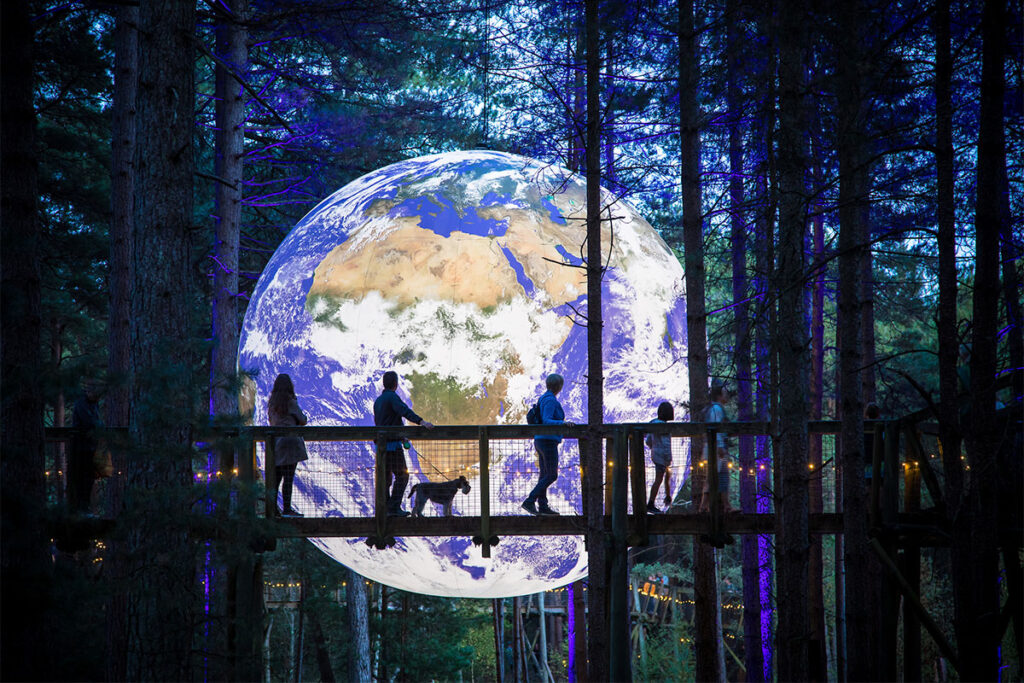
As part of the Cultural Compact’s Action Plan, we designed three workshops, centred around environmental sustainability, delivered across Bournemouth and Poole during Autumn 2025, with the aim of connecting artists and organisations, as well as learning more about ways to ensure creative work is made and shared in environmentally sustainable ways.
We were delighted to be joined by Sian Alexander (Lead Facilitator), who brought along decades of experience in this field. She was a brilliant
presence within the room and empowered attendees to enjoy these conversations.
Exploring our role in a changing climate:
David Buckland, director of Cape Farewell, spoke about his practice – bringing together artists and scientists to collaborate on new work. Using his recent film, ‘Our Life is Here’, about the inhabitants of the Marshall Islands, as an example, David revealed his ultimate maxim – ‘Climate is Culture’. As Cape Farewell are based near Dorchester, David also talked about Dorset’s environment and showed the different engagement opportunities he’s developed, inspired by local chalk rivers.
Learning Ponts:
It’s important to look after ourselves as we engage with the climate crisis. It’s an overwhelming topic, so it’s better to start with simple actions –
individuals, locals, and build from there. Better to do something small than nothing at all.
The Climate Crisis disproportionally impacts the global south and marginalised groups. It’s important to recognise the different nuances and embrace the positives that come with wider collaborations, locally, nationally, and internationally.
Local artists are already making great projects in response to the climate crisis. We should better amplify these projects when they happen, and also consider additional ways to engage with underserved groups.
Reducing our own climate impacts:
Rachael Duthie, a SW-based production manager and designer, spoke about how she has helped to create SAGE Exeter, a network of artists
and organisations seeking to share information and resources with the aim of reducing our own climate impact. Rachael also talked through the Theatre Green Book and how it could be used across different artforms to guide creatives and companies towards more sustainable ways of working.
Learning Points:
Making work in a sustainable way is often more costly than it would be otherwise, so there are many benefits to sharing resources (set, props,
marketing materials). Feel empowered to be inventive. What are the other ways of doing things? Slow touring, using found materials, etc.
Concerns over the ubiquity of AI and whether it’s unavoidable in the current climate. Suggestions about when it is needed and when it
clashes with our values. It can feel hopeless but actually we have power, as individuals and as organisations, to decide not to use it (or use it sparingly).
Julie’s Bicycle and Theatre Green Book both offer specific examples of ways to reduce climate impact. Highly recommended to use as a
baseline when creating new projects, and explore ways to adapt them for other art forms.
Adapting to our changing climate:
Tom Clarke from the National Trust, came to talk about how the climate crisis is affecting Purbeck and East Dorset, referring to increased
instability that is affecting local wildlife. The Trust are working hard to engage different community groups across Purbeck, especially those who might not ordinarily engage with their landscape, with special events and workshops helping to remove barriers to access.
Learning Points:
The stories we tell have an impact on the climate, and it’s important to develop useful narratives around them. If more people care about
where they live, then they will make more of an effort to protect it/look after it in the future.
BCP and East Dorset is already being affected by the climate crisis (flooding, sea levels, hot summers). It’s important to consider the impact this might have on communities, and ways we can adjust as artists. More shows in communities? Open-air productions? Importance of air conditioning in summer, heating in winter?
Sustainable choices often take longer, so how do we slow down? Ensure freelancers are paid fairly. Put pressure on larger companies and organisations making bigger, more negative impacts on the climate.
What can we take away from these workshops?
Carbon Literacy – Christine Eyre joined us and talked about the carbon literacy training she delivers to small organisations across BCP.
WhatsApp Group – Would you like to join a BCP Cultural Compact WhatsApp group? Email your details to Info@CulturalCompact.org.uk and we’ll get started.
Unity – It can feel overwhelming to talk about these huge ideas, but we have agency as individuals and there is still hope.
These workshops were a brilliant starting point, giving us tools to better discuss the climate crisis and ideas to develop new projects in
2026 and beyond. If you’d like to review the full document, then drop us an email and we’ll be happy to share.
(photo courtesy of Activate Performing Arts)